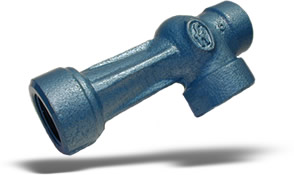
 Steam Jet Syphons operate on the steam jet principle utilizing the energy of steam under pressure to pump, mix liquids and handle solids. They can be used for the handling of corrosive or abrasive liquids and solids because of their design simplicity and the absence of moving parts. Steam Jet Syphons operate on the steam jet principle utilizing the energy of steam under pressure to pump, mix liquids and handle solids. They can be used for the handling of corrosive or abrasive liquids and solids because of their design simplicity and the absence of moving parts.
S&K syphons offer numerous advantages. Within the syphon, there are no moving parts to wear or break, and thus nothing to require extensive maintenance. Since the syphon is small in relation to the work it does, the cost is correspondingly low. Easy to install, they may be located in remote and inaccessible places without requiring constant attention.
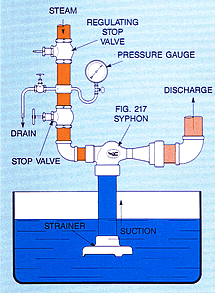
In operation, steam under pressure discharges at high velocity through a nozzle and entrains the suction liquid or slurry. The steam and suction fluid are mixed intimately in the specially designed diffuser of the syphon and are discharged against counter pressure. The pressure steam, which passes through the nozzle at high velocity, is condensed by the suction liquid, raising its temperature. Density, viscosity, specific heat, discharge head and suction pressure of the pumped liquid all influence the temperature rise. Steam jet syphons will not operate if the temperature rise brings the liquid to the boiling point. For proper operation, complete condensation of the motive steam in the syphon is required.
Syphons are especially well suited for processes where heating is required in addition to pumping since the pumping is accomplished for the cost of the heating. Some of their uses include intermittent pumping of liquids from tanks and pits, pumping filtrate from vacuum vessels and condensate from surface condensers, supplying heated water to the jackets of stills and graining bowls, removing liquid from pickling baths, extracting chemicals in reaction chambers, moving powdered material or material in granular form. filling and emptying gas holder tanks, handling soap solutions in textile plants, pumping sugar juice and various liquids in canning plants.
Although the types shown in this bulletin will meet many normal requirements, specific applications and operating conditions often require design modifications. Our engineers will work with you to design a syphon for your purpose. |
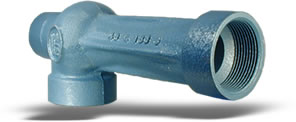 APPLICATION: Fig. 217 and Fig. 219 Steam Jet Syphons are designed for liquid pumping and mixing operations and for the handling of some solids where requirements do not necessitate capacities greater than those obtained with sizes up to and including 6". It is considered the standard syphon within this size range. APPLICATION: Fig. 217 and Fig. 219 Steam Jet Syphons are designed for liquid pumping and mixing operations and for the handling of some solids where requirements do not necessitate capacities greater than those obtained with sizes up to and including 6". It is considered the standard syphon within this size range.
 CONSTRUCTION: The Fig. 217 syphon has a streamlined body with threaded pipe connections. The steam nozzle is threaded to the body and can be removed for cleaning or replacement. Made in sizes from 1/2 " to 3", the Fig. 217 Syphon is stocked in cast iron, bronze, and in Type 316 stainless steel. CONSTRUCTION: The Fig. 217 syphon has a streamlined body with threaded pipe connections. The steam nozzle is threaded to the body and can be removed for cleaning or replacement. Made in sizes from 1/2 " to 3", the Fig. 217 Syphon is stocked in cast iron, bronze, and in Type 316 stainless steel.
Fig. 219 Syphons are made in 4" and 6" sizes with flanged connections. removable steam nozzle and throat bushing. They are stocked in cast iron, bronze mounted and can be supplied in other materials on special order.
Both Fig. 217 and Fig 219 Syphons are available with either Type 60 or Type 115 nozzles. When ordering, the nozzle type should be specified. The two nozzle types provide different capacities, as shown in Tables 2 and 4 on the next two pages.
OPERATION: Steam under pressure enters the syphon and produces a high velocity jet. This jet action creates a vacuum in the line causing the suction material to be drawn into the body of the syphon where it is entrained by the steam.
Steam and suction material are mixed in the throat or diffuser of the syphon and are discharged against back pressure. The body, which has no pockets, prevents solids in the suction material from collecting and clogging the syphon. In addition, pressure drop in the suction chamber is held to a minimum. Fig. 217 Syphons operate best at a definite steam pressure. |