
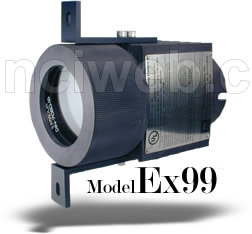
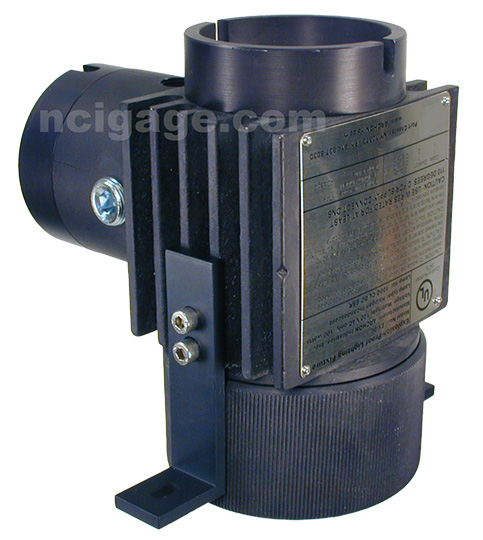
Model EX-99 Explosion Proof Lighting Fixture
Installation • Operation • Maintenance Instructions
1. Suitability
1.1 This fixture is suitable, when installed and operated in accordance with these instructions, for use in the following locations as defined by the National Electrical Code:
| Class | Division | Groups |
|---|---|---|
| I | 1 | C and D |
| I | 2 | C and D |
 1.2 This fixture is rated for Temperature Code T4A for a maximum ambient temperature of 40°C (104°F).
2. Installation
2.1 Install and use in accordance with all applicable electrical and fire safety codes.
2.2 Ensure electrical service leads are properly protected against mechanical damage.
2.3 CAUTION: To reduce the risk of fire or explosion, do not install where the marked operating temperature exceeds the ignition temperature of the hazardous atmosphere.
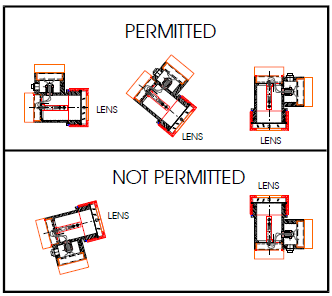
2.4 CAUTION: Mount this fixture at any angle between the glass lens facing down and the glass lens facing horizontally. Do not mount this fixture with the lens facing at any angle above the horizontal. (See Figure 1)
2.5 CAUTION: Use only Halogen incandescent lamp type, model number 100Q/CL/DC ESR with this fixture.
2.6 CAUTION: Use wires rated for at least 110°C (230°F) for supply connections.
 3. Operation
3.1 CAUTION: To reduce the risk of ignition of hazardous atmospheres, disconnect the fixture from the electrical supply circuit before opening any of the covers.
3.2 Do not energize the fixture if the glass lens is cracked or broken, or if the lens cover is not screwed on tightly.
3.3 Ensure that the lens is securely held in the fixture before energizing the electrical supply circuit. The lens should not be free to move when properly installed. Screwing on the lens cover fully over the lens onto the fixture body will properly secure the lens so that the lens is not free to move in the cover.
3.4 Ensure that all covers are tightly closed when the fixture is in operation.
4. Lamp Removal and Installation
4.1 Use only the specified replacement lamp.
4.2 Do not replace the lamp from the lens side by removing the lens cover.
4.3 Replace the lamp only from the anti-lens side by removing the screw-in cover from the fixture body to expose the bulb receptacle mounting plate.
4.4 Feed the slack in the wire leads through the mounting plate holes into the lamp compartment.
4.5 Extract the mounting plate, with the receptacle and the lamp, from within the fixture body by pulling back and then rotating the mounting plate to expose the lamp. Do not pull the wire leads.
4.6 Note the lamp is a spring-loaded bayonet style mount. Remove the lamp from the receptacle by rotating the lamp while gently pushing the lamp into the receptacle in order to free the lamp.
 4.7 Follow the instructions provided with the replacement lamp when installing. Do not directly contact the lamp glass envelope with fingers. Use a barrier such as clean cloth or paper when handling the lamp. Contaminants such as body oils can result in premature bulb failure.
Figure 1: Mounting Orientations
PERMITTED
- Lens facing downward
- Lens facing horizontally
NOT PERMITTED
- Lens facing at any angle above the horizontal
Instruction No. 1015
NEC Class I Locations Explained
The National Electrical Code (NEC) — officially NFPA 70 — classifies hazardous (classified) locations in Article 500. These classifications help determine what type of electrical equipment is safe to use in areas where flammable or explosive materials may be present.
Class I specifically covers locations where flammable gases, vapors, or flammable liquid are (or may be) present in the air in quantities sufficient to produce explosive or ignitable mixtures.
Class I locations are further broken down by **Division** (likelihood of the hazard) and **Group** (type of gas or vapor).
Divisions: How Likely Is the Hazard?
- Division 1 (higher risk)
Ignitable concentrations of flammable gases or vapors:
- Exist under normal operating conditions, or
- Occur frequently because of repair, maintenance, or leakage, or
- Could be released due to equipment breakdown or faulty operation (simultaneous with electrical failure).
- Division 2 (lower risk)
Flammable gases, vapors, or liquids are normally handled in closed systems. Ignitable concentrations are not likely** under normal conditions but could occur under abnormal conditions (e.g., accidental rupture, equipment failure, or ventilation breakdown).
Groups: What Substance Is Present?
Gases and vapors in Class I locations are grouped (A–D) based on their ignition properties, explosion pressure, and maximum experimental safe gap (MESG).
| Group | Typical Substances | Examples of Locations |
|---|---|---|
| A | Acetylene | Acetylene manufacturing or storage |
| B | Hydrogen, manufactured gases containing >30% hydrogen | Hydrogen production, battery rooms |
| C | Ethylene, diethyl ether, cyclopropane | Chemical plants, ethylene processing |
| D | Propane, gasoline, natural gas, butane, methane, acetone | Petroleum refineries, gasoline stations, paint booths, utility gas plants |
Why This Matters for Equipment
Electrical equipment used in Class I locations must be specially designed (e.g., explosion-proof, purged/pressurized, or intrinsically safe) so it cannot ignite the surrounding atmosphere — even during normal operation or in the event of a fault.
Connection to your EX-99 fixture
The Northeast Controls Model EX-99 Explosion-Proof Lighting Fixture is rated for Class I, Division 1 and Division 2, Groups C and D, T4A. This makes it suitable for many petrochemical, refinery, chemical processing, and fuel-handling areas where ethylene, propane, gasoline, or similar materials are present (but not for acetylene or hydrogen environments).
Additional Notes
- Equipment must also meet the Temperature Code (T-rating) of the location. T4A (as marked on the EX-99) means the fixture’s maximum surface temperature will not exceed 120°C (248°F), well below the ignition temperature of most Group C and D materials.
- The NEC also allows a **Zone** classification system (Zone 0, 1, 2) in some cases, but most U.S. facilities still use the Class/Division system for Class I.