Ultrasonic transmitters send a pulse of ultrasound
down to the liquid surface and detect the reflected echo. An
internal microprocessor, which is pre-programmed with the speed
of sound, can then translate the time taken for the pulse to
be returned into the distance between the transmitter face and
the liquid surface. An integral temperature sensor in the transmitter
compensates for temperature change effects on the speed of sound
in the ullage space. Having established this basic
distance, the transmitter calculates the depth of liquid and
sends this information back to the control unit as a 4-20mA signal
proportional to level. Alternatively, a ceramic cell hydrostatic
pressure transmitter can be used to sense liquid level and provide
the 4-20mA signal to the control unit.
The control unit uses this information to drive control relays
which can be freely assigned by the operator. Alternatively,
tank contents or volumetric flow in an open channel flow application
can be calculated. There are 5 built-in relays and a
4-20mA current output A clear 4 line display on the unit shows
the measured variable or may be programmed to show other operational
information. A bargraph representation of the current output
and relay status are also displayed.
Programming is simple and efficient using the integral membrane
keypad on the face of the control unit. The menu structure
is easy to navigate |

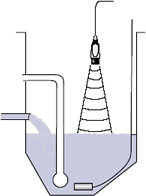 The transmitter is mounted over the liquid surface
using the 1 " threaded connection provided. A locking backnut
and bracket is supplied which facilitates mounting the transmitter
from a spar or strut above the sump. If a hydrostatic head pressure
transmitter is used for level sensing, the transmitter is usually
suspended in or clamped to the bottom of the sump.
The transmitter is mounted over the liquid surface
using the 1 " threaded connection provided. A locking backnut
and bracket is supplied which facilitates mounting the transmitter
from a spar or strut above the sump. If a hydrostatic head pressure
transmitter is used for level sensing, the transmitter is usually
suspended in or clamped to the bottom of the sump. 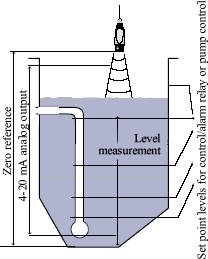 Pump control relays and functionality The MSC pump
control system has 5 relays which may be allocated to control or
alarm duty, all programmed independently and all freely assignable
To meet the needs of the water industry, the following features
are provided as standard: -
Pump control relays and functionality The MSC pump
control system has 5 relays which may be allocated to control or
alarm duty, all programmed independently and all freely assignable
To meet the needs of the water industry, the following features
are provided as standard: -